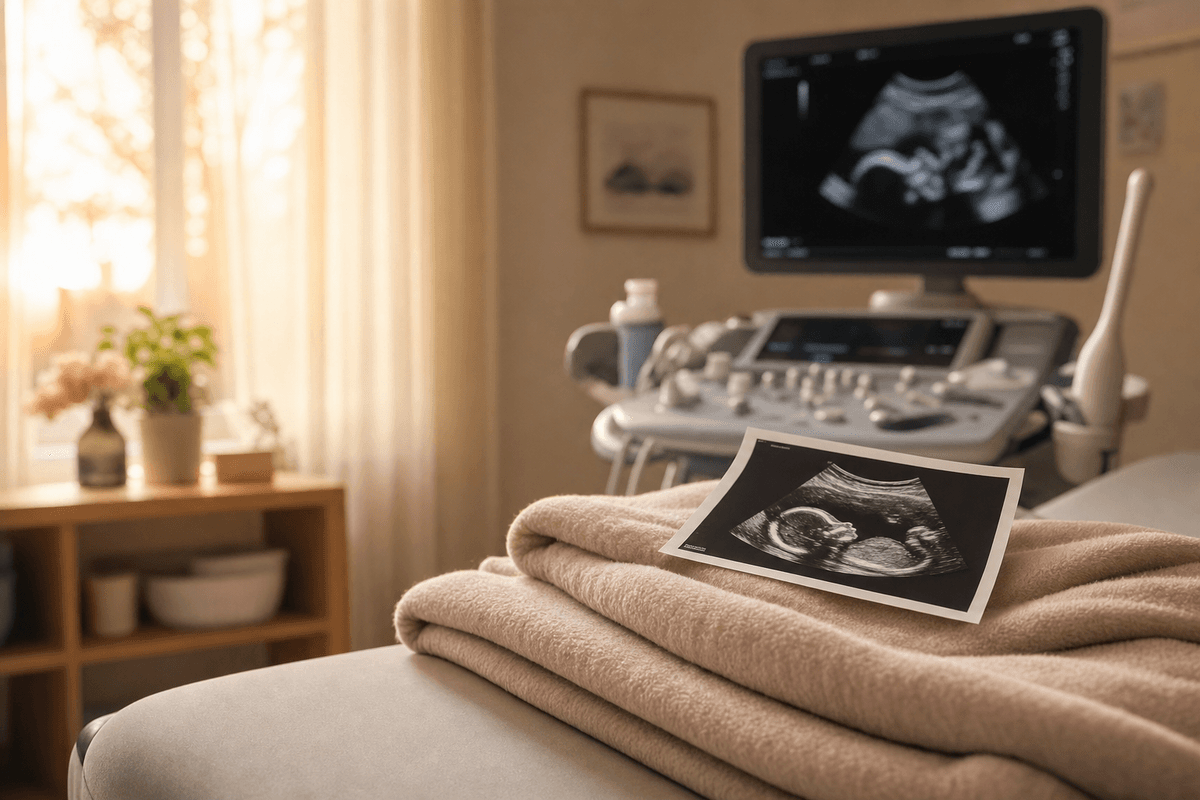
Anterior Placenta: What It Means for Feeling Your Baby Move
An anterior placenta sits on the front wall of the uterus and is a normal variation. Mostly it means you may feel kicks a little later and softer.
Thomas Lambert, MD··4 min read
If your anatomy scan came back noting an "anterior placenta," you may have left wondering whether it's a problem. For the vast majority of moms, it isn't — it's simply a description of where your placenta attached, and the main thing it tends to affect is how soon and how strongly you feel your baby kick. Here's what it means and what to expect.
What "anterior placenta" means
Your placenta can attach to different spots on the inside wall of your uterus — the back, the front, the top, the side. An anterior placenta is one that's attached to the front wall of the uterus, between your baby and your belly. It's a common, normal variation in placement, not a defect or a complication.
Think of it as the placenta setting up shop on the front wall instead of the back. Where it lands is mostly a matter of where the fertilized egg implanted, and an anterior position on its own doesn't mean anything is wrong with your pregnancy or your baby.
How it affects feeling your baby move
Here's the practical part — the one most moms actually notice. With an anterior placenta, there's an extra cushion (the placenta itself) sitting between your baby and the front of your belly. That cushion can muffle your baby's early movements, so:
You might feel those first flutters a bit later than moms with a posterior (back-wall) placenta.
Early kicks can feel softer or more muted, since they're padded by the placenta.
You may feel movement more off to the sides or lower down, rather than dead-center.
None of this means your baby is moving less — just that the signal is buffered. As your baby grows stronger, most moms with an anterior placenta do start feeling clear, regular movement; it may just take a little longer to tune in. (More on feeling your baby move.)
Why this matters for movement counting
This is worth knowing because so much pregnancy advice centers on paying attention to your baby's movements. With an anterior placenta:
Get to know your baby's pattern, whatever it is, rather than comparing to a friend's. What's normal for you is the baseline that matters.
Don't panic about muted early kicks — that's expected with a front-positioned placenta.
Still take a real change seriously. Once you're feeling regular movement, a noticeable decrease or change in your baby's usual pattern is always worth a call, anterior placenta or not. The placenta padding doesn't change that rule. (Here's when to worry about baby movement.)
Does it cause any problems?
For the most part, an anterior placenta is a non-issue beyond the movement-feeling difference. A couple of small practical notes:
It can occasionally make it slightly trickier for a provider to find the heartbeat with a handheld monitor, or change the approach for certain procedures — minor logistics your team handles routinely.
It's separate from a low-lying placenta or placenta previa, which is about the placenta being near or over the cervix — a different finding. Anterior just refers to front-versus-back.
Your team will note its position and keep an eye on it as they would any placenta.
So if you've been told you have an anterior placenta, you can file it under "good to know" rather than "something to worry about." Expect to feel those first kicks maybe a little later and a little softer, learn your baby's own rhythm once movement settles in, and keep the same rule everyone follows: a real change in your baby's established pattern is the thing to call about.
This content is general educational information about pregnancy, birth, and obstetric anesthesia. It is not medical advice and does not replace a conversation with your own doctor. Every birth is different. Talk to your healthcare team about what's right for your specific situation.
Get the free guide first, then new articles as they publish.
If this explanation helped, the newsletter delivers the rest of the library one topic at a time.