Thomas Lambert, MD · OB Anesthesiology
Better Maternal Outcomes Start With Better Anesthesia Communication.
Experience teaches what to look for — not always what to question. I help institutions close the gap between what teams know and what patients understand.


Background
Clinical, Academic, Research
I completed my OB anesthesiology fellowship at Ohio State Wexner Medical Center, where the volume and acuity shaped how I think about both routine care and the moments when routine breaks down. I currently hold an academic appointment at Florida State University College of Medicine.
My committee work with ASA and SOAP keeps me connected to the policy and quality conversations happening at the national level — and my research focus is on translating those conversations into protocols that departments can actually implement.
At the 2024 SOAP Annual Meeting, I presented six research abstracts spanning maternal safety, enhanced recovery, and simulation-based education.
Affiliations
Credentials
Board-Certified OB Anesthesiologist
Subspecialty focus in obstetric anesthesia
OB Anesthesiology Fellowship
Ohio State Wexner Medical Center
Clinical Assistant Professor
FSU College of Medicine
ASA Committee on Obstetric Anesthesia
National committee member
SOAP Centers of Excellence Committee
Quality and safety standards
6 Research Abstracts
2024 SOAP Annual Meeting
For Hospitals
How I Work With Institutions
Flexible engagement models tailored to your department’s size, goals, and where you are in the process.
Consulting
Protocol Development & QI
The gap between published evidence and bedside practice is where most preventable harm lives. I work with departments to build protocols that close that gap — not by adding complexity, but by making the right thing the easy thing.
- Evidence-based protocol design for labor analgesia and cesarean anesthesia
- Quality improvement program architecture and outcome measurement
- SOAP Centers of Excellence preparation and benchmarking
Training
Education & Simulation
Simulation done well builds muscle memory for the moments when thinking slows down. I design scenarios that pressure-test coordination, not just individual skill — because obstetric emergencies are team failures or team saves.
- High-fidelity simulation for peripartum hemorrhage and airway management
- Residency and fellowship curriculum development
- Competency assessment and structured debriefing
How It Works
Engagement Process
A clear path from initial conversation to measurable results.
Conversation
A brief discussion about your department’s goals, challenges, and where you are in the process.
Assessment
Review of current protocols, training programs, and quality metrics to identify the highest-impact opportunities.
Tailored Engagement
A custom scope — from a single workshop to ongoing consulting — designed around your department’s priorities and timeline.
Measurable Outcomes
Clear metrics and structured follow-up to track whether changes actually moved outcomes and team performance.
The departments that improve most aren’t the ones with the biggest budgets or the newest equipment. They’re the ones willing to look honestly at their own workflow — and build systems that make the whole team better.
Thomas Lambert, MD
Speaking
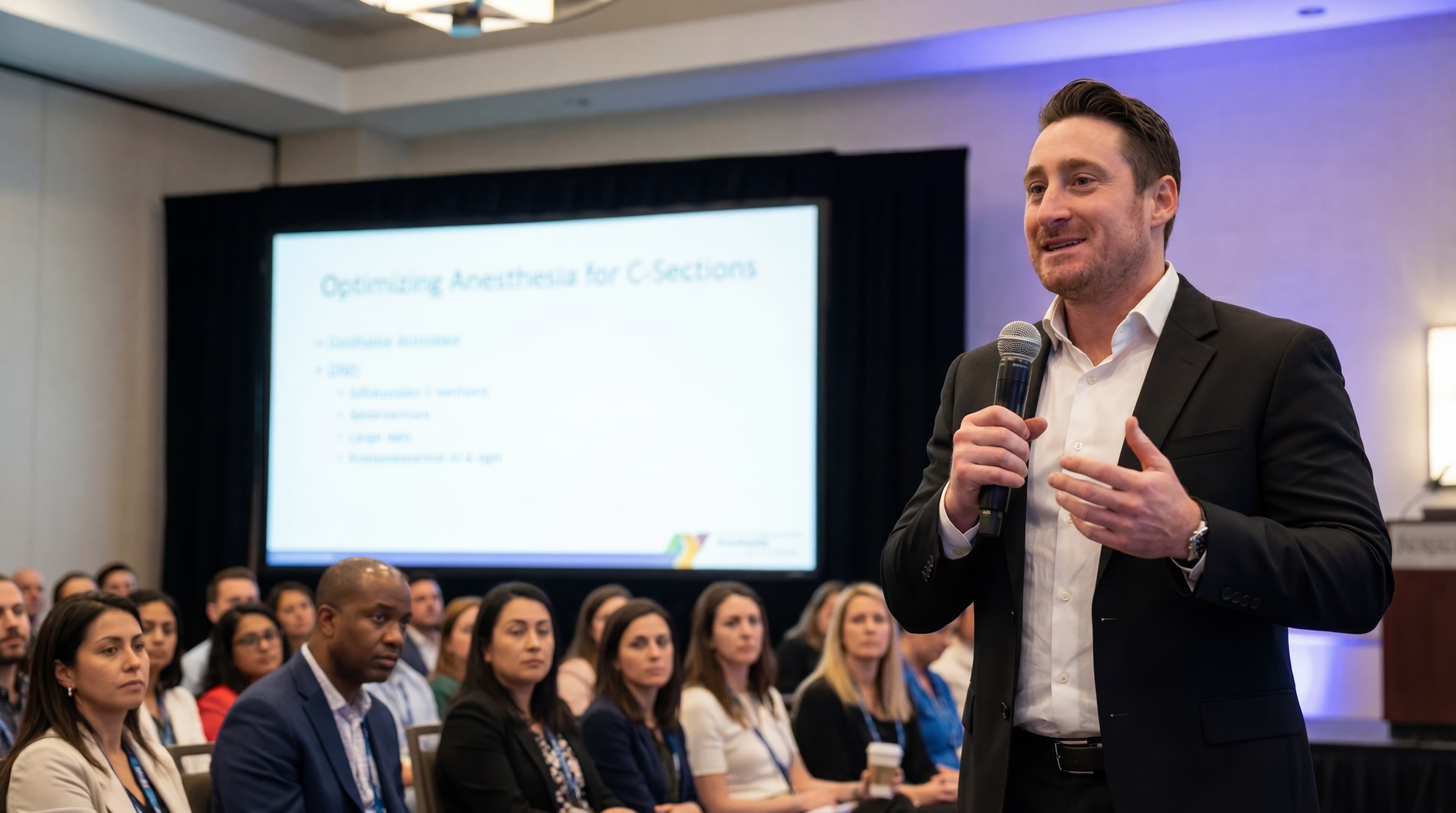
Keynotes & Education
Keynotes and education on maternal safety and anesthesia. For conferences, hospitals, and leadership teams committed to improving communication and outcomes.

Speaking Engagements
In my experience, the talks that change practice aren’t the ones that present new data — they reframe familiar problems so that teams see their own workflow differently. I design presentations around that principle: evidence-based, clinically grounded, and structured to provoke the kind of questioning that leads to better coordination.
- Conference keynotes and plenary sessions
- Grand rounds and departmental lectures
- CME-accredited programming
- Multi-day workshop intensives
Presentation Topics
Each presentation is tailored to your audience, department size, and institutional goals.
Featured
Evidence-Based Obstetric Anesthesia Protocols
The literature moves faster than most departments can implement. This talk distills current evidence into practical, implementable frameworks for labor analgesia and cesarean anesthesia — with an honest look at where the data is strong and where we’re still extrapolating.
Maternal Safety and Perioperative Risk Assessment
Risk stratification in obstetric anesthesia is often ad hoc. I walk through systematic approaches to identifying and managing high-risk patients in the pre-operative evaluation, with emphasis on what gets missed when the system is busy.
Enhanced Recovery After Cesarean (ERAC)
ERAC programs look straightforward on paper. In practice, the coordination between anesthesia, obstetrics, nursing, and pharmacy is where implementation stalls. This session covers the evidence, the common failure points, and what measurable improvement actually looks like.
Simulation-Based Training for Obstetric Emergencies
Designing scenarios that actually change team behavior — not just check a box. Covers high-fidelity simulation for peripartum hemorrhage, failed airway, and high spinal management, with emphasis on debriefing techniques that stick.
Patient Communication and Shared Decision-Making
Pre-operative conversations in obstetric anesthesia tend to be either too brief or too technical. I present a structured approach that reduces anxiety, improves satisfaction, and supports informed consent — without adding time to an already compressed workflow.
I’d Welcome the Conversation.
Whether it’s a single grand rounds talk or a longer collaboration around protocols and training — the right starting point is usually a conversation about what your team is seeing and where the friction lives.