

Pain Relief
Pain Relief in Labor Is Not One Single Path
Pain relief in labor isn't one decision. It's a toolkit you can mix, sequence, and change. Here's the realistic menu, from movement to epidural.
April 7, 2026 · 5 min read
Pain Relief
Breathing techniques for labor, stage by stage: slow, lighter and pant-blow patterns, pushing, box breathing, Lamaze vs Bradley, and when to practice.
 Thomas Lambert, MD9 min read

Breathing techniques for labor are simple ways to keep your breath slow and steady through a contraction, so you can relax, stay in a rhythm and cope with the hard work your body is doing. Most guides start with slow, deep breaths in early labor and move to lighter, quicker patterns as contractions get stronger. Sutter Health puts it plainly: there's no right or wrong way to breathe in labor, and the techniques are guidelines you can adapt to what feels best for you.
It helps to be clear about what breathing can and can't do. It's a coping tool, not a medical pain block. In Sutter's words, breathing can't take labor pain away, but it can help you feel calmer, more focused and more in tune with your body. A Cochrane review of relaxation techniques for labor pain, which included breathing among the methods studied, included 19 studies with 2,519 participants, 15 of which (1,731 participants) contributed data. The authors concluded that relaxation, yoga and music may have a role in reducing pain and increasing satisfaction with pain relief, while rating the quality of that evidence as low to very low.
There are a few reasons slow, focused breathing tends to help. Lamaze International explains that conscious breathing, especially slow breathing, reduces heart rate, anxiety and pain perception, partly because when breathing becomes your focus, other sensations move to the edge of your awareness. The HSE in Ireland adds that focused breathing directs your thoughts away from discomfort, which can help reduce tension in your muscles.
Breathing also sits comfortably next to other options. The American College of Obstetricians and Gynecologists (ACOG) lists relaxation and breathing techniques taught in childbirth class among the nonmedical ways to ease discomfort, and notes these approaches can be used alone or in addition to medication. ACOG's committee opinion on limiting intervention in labor says multiple nonpharmacologic and pharmacologic techniques can be used to help moms cope with labor pain.
One question that comes up often is whether breathing can make your cervix dilate faster. None of the sources in this guide describe breathing as a way to speed up dilation. Its job is to help you cope while your body does that work. If you're curious how dilation is actually measured, this guide to dilation and effacement walks through it.
Most labor breathing patterns share two simple tools. The first is a cleansing breath. Sutter describes it as a deep, exaggerated breath at the start and end of a contraction, in through your nose and out through your mouth. It signals that a contraction is beginning, lets your partner know so they can support you, and helps release tension once the contraction is over.
The second is a focal point, something to rest your attention on. You might picture a peaceful place, look at an object in the room or look into your partner's eyes. Sutter suggests practicing with a few different focal points ahead of time, and skipping the clock, since watching time pass can make things feel harder.
The patterns below follow the way many hospital classes teach them. Think of them as a menu rather than a script. Sutter notes you can mix patterns within a contraction, and Lamaze notes that what works best will probably change as you move through labor.
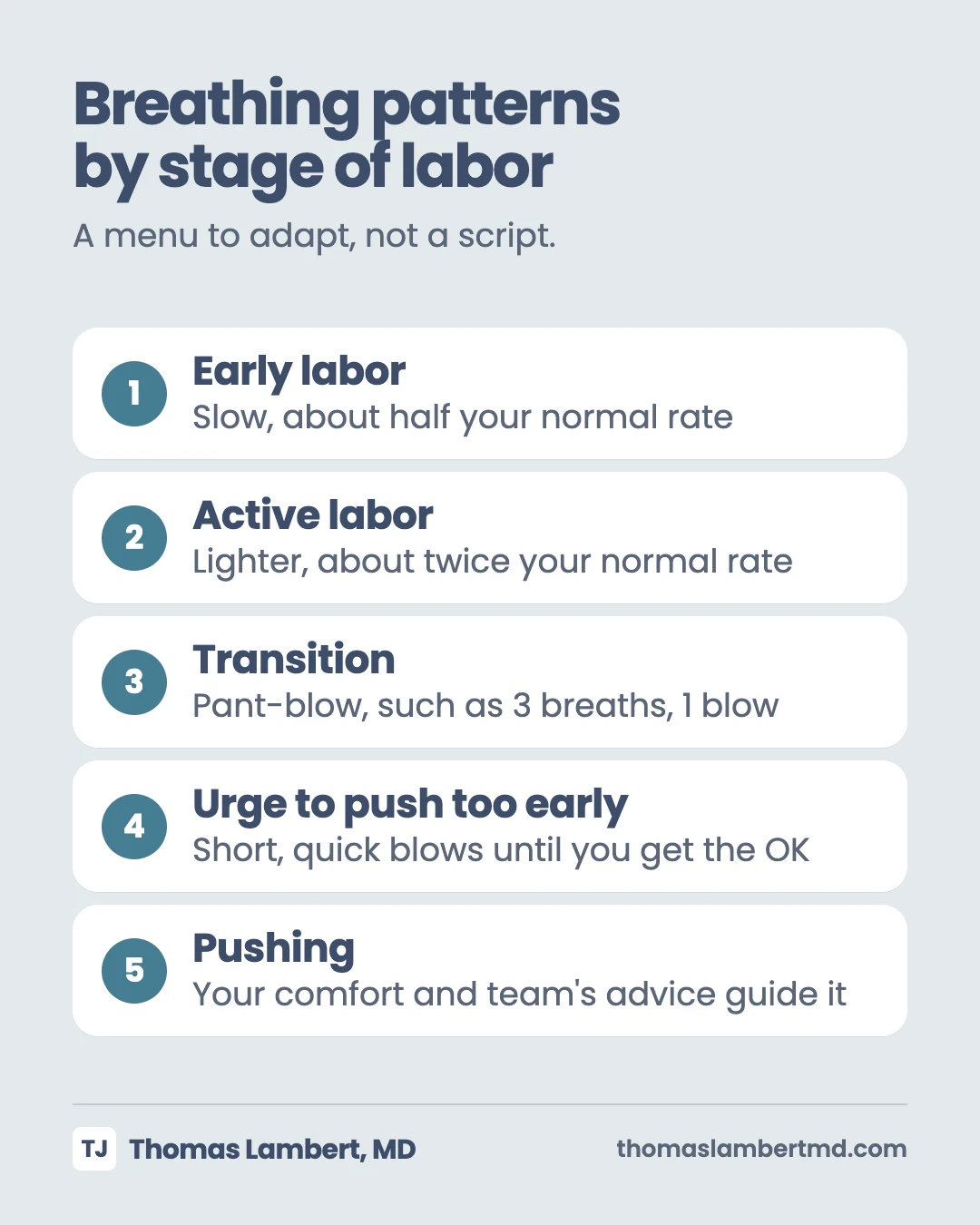
This is the pattern most guides start with. Sutter describes slow-paced breathing as breathing in and out slowly, about half your normal breathing rate, starting and ending with a cleansing breath. The NHS notes that breathing exercises, massage and a warm bath or shower may help ease pain in this early stage.
To practice the belly breathing behind it, the HSE suggests these steps:
As contractions get stronger, slow breathing may stop feeling like enough. Sutter describes modified-paced breathing as easy, steady breathing at about twice your normal rate, using more chest movement than belly breathing, and helpful during stronger contractions. Lamaze describes the same shift as faster, shallower breathing, like a dog gently panting.
Transition is the stretch of labor just before the pushing stage. Sutter's patterned-paced breathing keeps an even rhythm at about twice your normal rate and adds a gentle blow, such as 3 breaths and 1 blow. Variations can range from 1 breath and 1 blow to 6 breaths and 1 blow, and you can mix patterns within a contraction. North York General Hospital teaches its shallow breathing for the transition stage, and notes that when it's used too early, moms often get very tired or dizzy. Its pant-blow version adds a short blow on the fourth breath, and between contractions you go back to normal breathing.
Sometimes the urge to bear down arrives before your team says it's time. Tell your nurse or midwife as soon as you feel it, since they may want to check you. The Ohio State University Wexner Medical Center's labor breathing guide suggests short, quick blows through your mouth, as if you're blowing out birthday candles, until the urge passes or your provider gives you the OK to push. More on that feeling is in this guide to the urge to push.
Once you're cleared to push, there are two broad styles. A Cochrane review of pushing methods describes directed pushing as taking a deep breath at the start of a contraction, then holding it and bearing down through the contraction. In spontaneous pushing, you follow your own instincts.
The review included 21 studies, 8 of them comparing spontaneous with directed pushing, and found no conclusive evidence to support or refute any specific pushing style as routine practice. The authors concluded that your preference and comfort, along with your clinical situation, should guide the choice. The North Bristol NHS Trust suggests trying to relax your pelvic floor muscles and not hold your breath while pushing. If your team coaches a different style, follow their lead and tell them what feels manageable.
Near the very end, breathing can help with a slower birth of the head. The NHS describes how your midwife may ask you to stop pushing and take some short breaths, blowing them out through your mouth. North Bristol explains that slow panting or gentle blowing lets the baby emerge more slowly while your midwife tries to avoid tearing. It isn't a promise of no tearing, and this overview of perineal tearing covers the rest of that picture. For positions that pair with your breathing, see this guide to pushing positions.
Cleveland Clinic describes box breathing as breathing in for a count of four, holding for four, breathing out for four and holding again for four, a technique used to relax in times of stress. It's a general calming exercise, not a labor-specific method, and none of the labor guides above list it as one of their contraction patterns.
It can still be a simple way to practice calm breathing during pregnancy. During contractions the breath holds may not suit you, and Cleveland Clinic itself recommends staying at your comfort level and not straining. If the holds feel like work, a slow breath in and a longer breath out is an easy swap.
These three names come up a lot, and they overlap more than they differ. Each one uses breathing and relaxation. They differ mostly in emphasis.
Lamaze. Patterned breathing used to be the hallmark of Lamaze classes. Today, Lamaze teaches that there's no "right" way to breathe in labor and that slow, deep breathing helps manage the pain of contractions. A Lamaze overview in the Journal of Perinatal Education describes conscious breathing as working best in combination with other comfort strategies, like movement, position changes and massage.
Bradley. The Bradley Method teaches natural childbirth with a partner as coach. It emphasizes relaxed abdominal breathing and relaxation throughout labor, and it encourages avoiding medication unless absolutely necessary. Its class series is 12 weeks, and the fifth month is its suggested time to start.
Hypnobirthing. The NCT describes hypnobirthing as a range of techniques including breathing, relaxation and visualization, aimed at reframing birth as challenging but positive. It can be used alongside pharmacological pain relief. A Cochrane review of hypnosis for labor included nine trials with 2,954 participants. It found that hypnosis may reduce the use of pain medication in labor, but not epidural use, and found no clear differences in satisfaction with pain relief, sense of coping or spontaneous vaginal birth. The authors rated the evidence as low quality, and very low for the pain medication finding.
The fairest takeaway is that the method you'll actually practice is likely to serve you better than the one that sounds best on paper.
There isn't one official start date. Sutter notes that these techniques work best with practice, so it helps to try them before labor begins. For hypnobirthing, the NCT suggests starting some weeks before the end of pregnancy to allow time to find and practice what works for you.
Practice doesn't need to be formal. Lamaze suggests using conscious breathing when everyday stress shows up, like being stuck in traffic or running late.
Breathing is something your partner can actively join. North Bristol suggests practicing breathing together before the birth. As you practice, a partner can time your breathing. Then they can breathe at the same rate as you, remind you of a phrase you're using and help you stay focused on breathing and relaxing throughout labor.
Eye contact as a focal point or a quiet count out loud can help bring your rhythm back if you lose it. A doula can offer the same kind of support.
Breathing isn't only for an unmedicated birth. Before an epidural, while you wait for it or if you decide against one, it's one of the tools you can use at any point. The range of pain relief options is wider than an either-or choice, and ACOG notes that nonmedical approaches can be used alone or in addition to medication.
With an epidural, breathing may play a different role at the pushing stage. The NHS explains that if you have an epidural, you may not feel an urge to push at all. Its pain relief guide adds that if you can no longer feel your contractions, your nurse, midwife or doctor will tell you when to push. Your breath then becomes a way to time and steady your effort with your team's guidance. This guide to pushing with an epidural covers what that typically feels like.
Fast breathing can bring on symptoms of its own. The antenatal handbook from Cork University Maternity Hospital warns that over breathing can lead to dizziness or pins and needles, and that the fix is to slow your breathing down. Go back to a slow breath in and a longer breath out, and let your nurse or midwife know.
If you have an epidural, tell your team right away about numbness or tingling around your mouth, a metallic taste, ringing in your ears or trouble breathing, rather than assuming it's your breathing. MedlinePlus lists these among the serious side effects of bupivacaine, a numbing medicine often used in labor epidurals, that need medical attention right away.
Some symptoms are not about breathing technique. The CDC's list of urgent maternal warning signs includes shortness of breath, a tight throat or chest, chest pain, a fast or pounding heartbeat, and feeling dizzy, faint or disoriented. In labor, tell your care team right away. At any other point in pregnancy or after birth, the CDC's advice is to seek medical care immediately. For sudden, crushing chest pain or breathing trouble that comes on suddenly or makes it hard to talk, MedlinePlus advises calling 911 (chest pain, breathing difficulty). If you're pregnant and feeling breathless at rest, this guide to shortness of breath during pregnancy explains which kind is expected and which kind needs urgent care.
Labor breathing isn't a test you pass or fail. It's a set of simple tools: a cleansing breath, a focal point, a slow rhythm and a lighter one when contractions build. Practice a little ahead of time, let your partner in on it and feel free to change patterns when your body asks for something else.
This content is general educational information about pregnancy, birth, and obstetric anesthesia. It is not medical advice and does not replace a conversation with your own doctor. Every birth is different. Talk to your healthcare team about what's right for your specific situation.
Notes on labor, pain relief and anesthesia from an obstetric anesthesiologist. The first email brings the free C-section preparation guide, a separate read to keep for later.
100% Free · Secure & Private
You'll get the guide plus occasional emails from Dr. Thomas, including offers for his paid guides. Unsubscribe anytime.
Pain Relief
Pain relief in labor isn't one decision. It's a toolkit you can mix, sequence, and change. Here's the realistic menu, from movement to epidural.
April 7, 2026 · 5 min read

Labor
A working epidural changes what pushing feels like, but it doesn't take away your ability to push. Here's what to expect and how your team coaches you.
May 28, 2026 · 5 min read

Labor
Transition is the intense final stretch of dilation, the moment many moms think they can't go on. Here's what it is and how to get through it.
May 28, 2026 · 4 min read