PDF Ebook
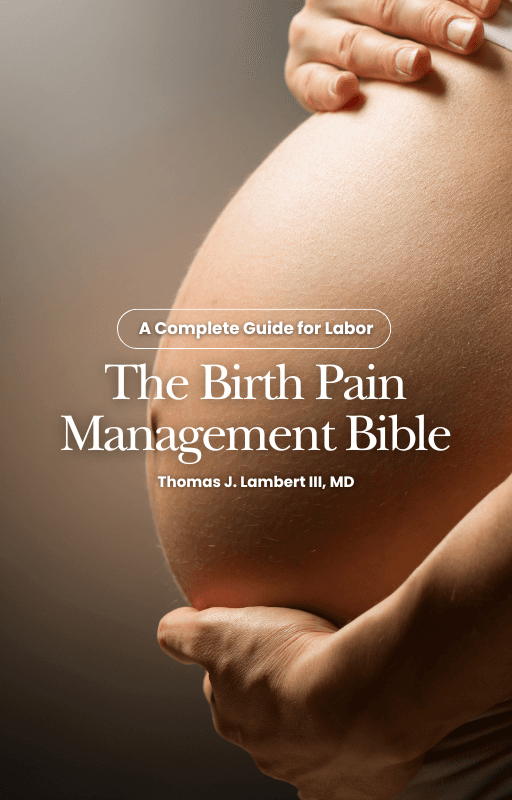
The Birth Pain Management Bible
If the other guides are focused answers, this is the whole library in one volume. The Birth Pain Management Bible is an obstetric anesthesiologist's evidence-based reference to every labor pain option — medical and not — framed not as a verdict but as trade-offs to weigh against what you actually want. There's no single best method; there's the one that fits you.
- Secure Stripe checkout
- Instant PDF download
- Yours to keep

Written by Thomas Lambert, MDBoard-certified obstetric anesthesiologist
The real question
There's no best method — only the one that fits you
Most pain-relief advice argues for a winner. But an epidural, a spinal, nitrous, IV opioids, and non-medical tools each have real strengths and real costs, and the right choice depends on your labor, your history, and what you're willing to trade.
This reference gives you the framework to compare them honestly — eight decision dimensions, a chapter on each method, the special situations that change the plan, and printable matrices you can carry — so you're choosing on your own terms, not someone else's.
Inside the guide
What’s inside
The comprehensive reference — every method, the framework to compare them, the special situations, and printable decision matrices to bring with you.
- 01
Pain Pathways in Labor
Where labor pain comes from — the anatomy that makes every other chapter click.
- 02
The Decision Framework
Eight dimensions to weigh methods against your own priorities.
- 03
Epidural
The most-used neuraxial method — how it works, who it suits, and the trade-offs.
- 04
Spinal
Fast, dense, short — the dominant method for planned cesareans.
- 05
Combined Spinal-Epidural (CSE)
The hybrid: a spinal's fast onset with an epidural's flexibility.
- 06
Walking Epidural: Language vs. Reality
What the term promises versus what most US hospitals actually allow.
- 07
Nitrous Oxide
The self-administered middle option — calming more than numbing.
- 08
IV Opioids
Systemic options for specific windows of labor, and their timing limits.
- 09
Movement, Water, Positioning, Breathing
The non-medical toolkit — modest alone, real in combination.
- 10
Doulas and Continuous Support
The most-studied non-medical intervention, and what the evidence shows.
- 11
Hypnobirthing and Mental Frameworks
The mindset methods, reviewed respectfully and bounded by the evidence.
- 12
C-Section Anesthesia
The three paths, what you feel, and gentle-cesarean options.
- 13
Special Situations
BMI, scoliosis, blood thinners, preeclampsia, anxiety, and more — when the plan changes.
- 14
Side Effects and Red Flags
The cross-method summary: what's normal, what to mention, what's urgent.
- 15
Decision Matrices
Printable side-by-side comparisons of every method across the key dimensions.
- 16
Glossary
Plain-language definitions of the terms used throughout.
What you'll walk away with
- A decision framework — eight dimensions — for comparing every pain-relief method on your terms
- A clear, honest profile of each option: epidural, spinal, CSE, nitrous, IV opioids, and non-medical tools
- What changes for special situations like high BMI, scoliosis, blood thinners, preeclampsia, VBAC, and anxiety
- The common side effects versus the genuine red flags, across every method
- Printable decision matrices and a pre-labor checklist to share with your team
Who this guide is for
- Moms who want the complete picture before choosing how to manage labor pain
- Anyone with a medical situation that changes the anesthesia plan
- Readers who'd rather have one comprehensive reference than a shelf of opinions

Who wrote this
Thomas Lambert, MD
Dr. Lambert is a board-certified obstetric anesthesiologist who spends his days in labor and delivery. He writes these guides the way he explains things at the bedside — plainly, without the fear — so you can walk in calm and ready, whatever you decide.
FAQ
Questions moms ask
- Does an epidural increase the chance of a C-section?
- No. Modern low-dose epidural studies don't show a higher cesarean rate. Older, higher-dose epidurals sometimes suggested it, but that hasn't held with today's low-dose approach.
- Can I ask for an epidural at any point?
- Yes. ACOG states that your request is sufficient reason and there's no minimum dilation to reach first.
- How common is the dreaded spinal headache?
- After a labor epidural it's roughly 1% overall. When it does happen it's very treatable — an epidural blood patch resolves the large majority of significant cases.
- Do doulas really make a difference?
- The evidence is unusually strong. A large Cochrane review links continuous labor support to more spontaneous vaginal births, shorter labors, less medication, fewer cesareans, and higher satisfaction — with no identified harms.
- Does hypnobirthing work?
- The honest answer: the evidence is weaker than for doula support or medical relief. Studies show only weak evidence for reduced medication use and no clear effect on pain scores — but it's safe, and many moms value the preparation it brings.
Start reading today
Birth doesn't reward the bravest method — it rewards the one that fits you. Keep this reference close, weigh the trade-offs on your own terms, and walk in calm and ready.
One-time payment · instant PDF download · yours to keep