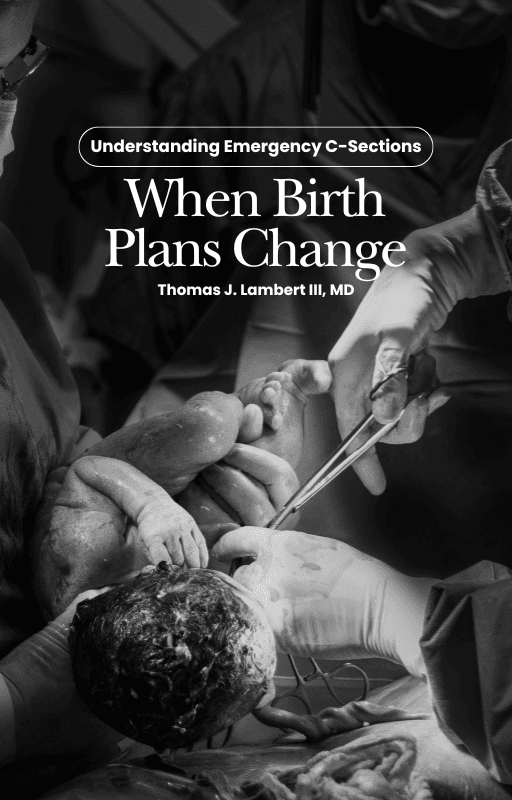
Free PDF Guide
When Plans Change: The Emergency C-Section
An unplanned or emergency C-section is frightening mostly because of the speed and the unknown — not because something has gone wrong with you. This free guide names exactly what happens when a birth plan changes, from the decision to the operating room to meeting your baby, so that if the day moves fast, you already know the choreography.
- No card required
- Instant PDF download
- Yours to keep

Written by Thomas Lambert, MDBoard-certified obstetric anesthesiologist
The real question
An unplanned C-section is the system working — not failing
Most unplanned cesareans aren't failures. They're the team responding to information that simply wasn't available before labor started — labor that stalls, a heart rate that needs a faster exit, or an event that calls for one.
What frightens moms is the pace and the unfamiliar room, not the decision itself. This guide walks the sequence minute by minute — the first five minutes, the three anesthesia paths, what you'll feel with a working block, and where your support person will be — so speed feels less like chaos.
Inside the guide
What’s inside
The full choreography of an unplanned cesarean — plus two printables: a questions page and a one-page quick reference.
- 01
Why Plans Change
The common reasons a cesarean becomes the plan — and why they're information, not failure.
- 02
Urgent vs. Emergency
What the team's words for urgency tell you about how fast things will move.
- 03
The First 5 Minutes
Decision to operating room, in order, when the room starts to move quickly.
- 04
What Anesthesia Is Doing
The team you can't quite see, and what they're working on the whole time.
- 05
Epidural Top-Up, Spinal, or General
The three anesthesia paths — when each is chosen and what to expect from it.
- 06
Pressure, Movement, and Pain
What a working block really feels like, and the exact words to use if it changes.
- 07
Where Your Support Person Is
Where your partner will be — which depends mostly on the anesthesia you have.
- 08
Right After Baby Is Born
The minutes between birth and recovery — for your baby and for your body.
- 09
Questions to Ask Before Delivery Day
A printable page that turns this guide into a conversation with your team.
- 10
Printable Quick Reference
One page: the shape of the day, the paths, what to say, what to call about.
What you'll walk away with
- The three most common reasons a cesarean becomes the plan — and why they're not your failure
- What the team's urgency words mean, and how fast each one usually moves
- The actual order of the first five minutes, so the room feels less chaotic
- The three anesthesia paths — epidural top-up, spinal, general — and when each is used
- What a working block feels like (pressure, yes; pain, no) and the phrase that gets the fastest response
- Where your support person will be, by anesthesia type, so you can both prepare for it
Who this guide is for
- Moms who want to be ready in case a birth plan changes on the day
- Anyone whose fear of a cesarean is really about the speed and the unknown
- Partners and support people who want to know where they'll be and how they'll be kept informed

Who wrote this
Thomas Lambert, MD
Dr. Lambert is a board-certified obstetric anesthesiologist who spends his days in labor and delivery. He writes these guides the way he explains things at the bedside — plainly, without the fear — so you can walk in calm and ready, whatever you decide.
FAQ
Questions moms ask
- Is an unplanned C-section a sign that something went wrong?
- Usually not. Most unplanned cesareans happen because labor revealed new information — stalled progress, a heart rate that needs a faster exit, or an acute event — and the team is adapting to it.
- What will I feel during a cesarean with a working epidural or spinal?
- A working block takes away pain but not all sensation — you may feel firm pressure, tugging, and movement, especially as the baby is lifted out. Sharp or burning pain is different and worth saying out loud right away.
- How fast is an emergency C-section?
- It depends on the urgency. Many urgent cesareans aim for about 30 minutes from decision to delivery; for the rare true emergency it can be much faster.
- Will my partner be with me?
- With an epidural or spinal, your support person usually comes in after the brief setup and stays by your head. Under general anesthesia they often wait nearby, and a nurse brings them to you and the baby soon after birth.
- Why might I need general anesthesia?
- It's reserved for the most time-pressured situations or when a spinal or epidural isn't safe for you. Teams generally keep it to a small share of cesareans.
Start reading today
If the plan changes, you won't be alone and you won't be in the dark. Knowing the choreography ahead of time is what lets you stay calm and ready.
No card required · instant PDF download · yours to keep
Related
Useful next options
$22.90
C-Section Confidence Pair
A two-guide C-section preparation set for planned and urgent situations.
View option
$29.90
C-Section Prep Pack
C-section preparation, emergency context, and consultation questions.
View option
$59.90
Complete Ebook Library
All 10 Dr. Thomas PDF guides in one library offer.
View option