

Pain Relief
Pain Relief in Labor Is Not One Single Path
Pain relief in labor isn't one decision — it's a toolkit you can mix, sequence, and change. Here's the realistic menu, from movement to epidural.
April 7, 2026 · 5 min read
Labor
A warm shower or tub is one of the simplest comfort tools in labor. Here's how water helps, when you can use it, and how it differs from a water birth.
 Thomas Lambert, MD4 min read
Ask labor nurses for an underrated, no-cost comfort tool and many will say the same thing: warm water — one of several non-medical ways through labor. A shower aimed at your lower back or a soak in a tub is one of the simplest and most effective ways to take the edge off labor pain, and it's available in some form at most hospitals and birth centers. Here's how it helps, when you can use it, and how laboring in water differs from a water birth.
Warm water works on labor pain through several gentle mechanisms at once:
Research on water immersion during the first stage of labor finds it reduces pain perception for many moms and, for some, reduces the amount of pain medication used. It won't erase labor pain, but it can meaningfully soften it.
Both work; they just fit different moments and setups.
Many moms move between the two, using the shower early and a tub later, or alternating with other comfort tools.
A few practical realities:
So think of warm water as a wonderful tool for the earlier and unmedicated stretches of labor, and as one you may trade for other forms of relief later.
This is an important distinction that trips moms up. Using water for comfort during labor — laboring in a tub or shower and getting out to deliver — is different from a water birth, where the baby is actually delivered underwater.
If a water birth specifically is something you're interested in, that's a distinct conversation to have with your provider and hospital well in advance, because availability and policies differ a lot. But you don't need a water birth to get the comfort benefits of water — laboring in the shower or tub gives you most of that on its own.
Warm water is one of labor's simplest comfort tools, easing pain through warmth, buoyancy, and relaxation, with a shower available almost anywhere and a tub adding the relief of weightlessness. It's a low-risk choice for early and active labor, mostly used before an epidural, and it pairs well with position changes and counter-pressure. Just keep the distinction clear: laboring in water for comfort is the everyday version, while delivering in water is a separate, hospital-specific decision. For most moms, the shower is right there, costs nothing, and is worth reaching for sooner than you might think.
This content is general educational information about pregnancy, birth, and obstetric anesthesia. It is not medical advice and does not replace a conversation with your own doctor. Every birth is different. Talk to your healthcare team about what's right for your specific situation.
If this explanation helped, the newsletter delivers the rest of the library one topic at a time.
Free · sent to your inbox in minutes
Pain Relief
Pain relief in labor isn't one decision — it's a toolkit you can mix, sequence, and change. Here's the realistic menu, from movement to epidural.
April 7, 2026 · 5 min read
Labor
When labor pain settles in your lower back and won't let up between contractions, that's back labor. Here's why it happens and how an epidural fits in.
May 28, 2026 · 5 min read
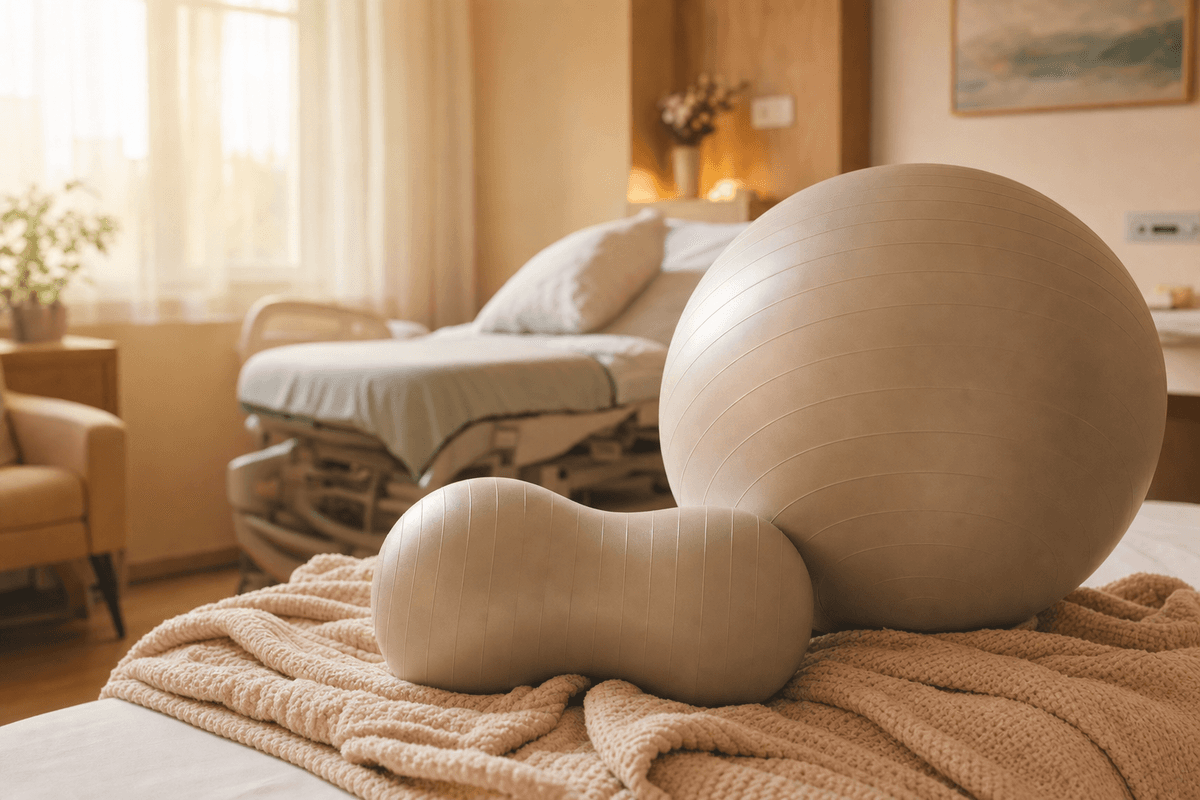
Labor
A big exercise ball and a peanut-shaped one are two of the most useful low-tech tools in labor — including with an epidural. Here's how to use each one.
May 28, 2026 · 4 min read
I acknowledge that: